-What is stupidity?
Today we looked at what stupidity is, and why it is so difficult to define. A question that was raised was "How can we understand stupidity if we don't understand knowledge?", which is essentially is what TOK explores.
" Only two things are infinite, the universe and human stupidity, and I'm not sure about the former" -Albert Einstein
A definition of stupid in the Oxford English Dictionary is as follows:
adj.
1) Lacking intelligence or common sense
2) Dazed and unable to think clearly
3) (informal) used to express exasperation or boredom
In the documentary we watched in class, these 'types' of definitions were what the people interviewed came up with. It seems to be the inability to think appropriately in an intellectual, social, or any sort of situation.In this sense, the expression of 'exasperation or boredom' fits as being bored takes our ability to think properly.
However, everyday we use the word 'stupid' in a much broader sense. Anything we don't approve of is 'stupid'. Where does this ambiguous word which all people use come from?
The documentary showed how humans have had a uncomfortable history with ignorance, and have avoided to confront the issue in a proper academic form. The IQ, which measures intelligence in a scientific manner, on the other hand of the scale also defines stupidity. The IQ test originally served to classify retardation in children, although now we tend to avoid the direct classification of people with low IQ as 'retarded'. Different words that compare levels of stupidity in people were clarified then.
There is also a tendency for people to opt for stupidity. Watching television is a almost brainless activity, which causes a state of virtual catatonia. We know this, yet at the end of the day when we are tired, we often want to watch television brainlessly. The whole commercial industry and the media is based around this concept of brainless activity. Yet it is 'commercial' because it reaches to wide audiences and makes money. So can stupidity be a type of social phenomena/disease? I think the fact that people are living in intellectual society which promotes knowledge means that on the other hand, intelligence is also used to create stupidity. Because there is intelligence, stupidity is created. It is like saying someone can only become healthy because unhealthiness exists, and if unhealthiness didn't exist, then there would be no pursuit for better health.
So what is stupidity? I don't know :)
Wednesday, May 9, 2012

Wednesday, May 2, 2012
Mathematics (cont.)
The Problem of Consistency; Beauty and Elegance; Mathematics in the Universe


Although Math seems like the most provable, definite area of knowledge, it has its flaws and paradoxes.
One example given in the lecture was Gottlob Frege's work, which involved trying to reduce all theories into simple arithmetic. Lord Russell challenged Frege's work at a fundamental level, concerning the 'set paradox'. This paradox was about a set containing all sets that are not members of themselves.
What happens with the set of the "sets that do not contain themselves as elements"? Now it seems that there are knot theories (diagram below) which can get around the set paradox.
With the problem showed in the lecture of whether N=0.999... is equal to 1, the 'paradox' created here depends upon our definition of infinity (quoted from my mom :) ). We can prove N to be 1 with simple algebra:
N = 0.99999
10N = 9.9999
Therefore
10N-N = 9.9999 - 0.9999
9N = 9
N = 1
The simplicity in this logic is satisfying. However if we were to really look into whether 0.999 does equal 1, we would look at if we define 0.9999 approaching 1 to be 1, thus how we define the infinite number of nines. When talking about beauty and elegance in math, I feel this type of discussion is what attracts people to pure maths.
Maths does have flaws, but mathematicians work on its flaws to correct them and explain how things work. In fact without its paradoxes and flaws, I'm not sure if there would be that many mathematicians in the world, because everything would work in perfect simple logic.
Then there is the question, is maths just a coincidence that math is so prevalent in reality? Was maths invented by people or was it discovered? Maths is a pure science, that is systematic and logical, as well as an art to create fundamental logic. It definitely to some point has been defined by people, as we can see in ancient civilizations where maths that began in different areas of the world came about differently.
I think it makes sense that maths works, because the universe was not created by pure randomness. When things happen there is normally a cause and effect, and if the universe was created by a chain of cause and effects, then it seems reasonable that things fell into place in a somewhat structured way. The coincidence of the Golden Ratio may not be explainable by human minds (at least currently). But the brain is a biological object which has cells, structure, science to it, and it seems logical that we react to certain ratios naturally.
Wednesday, April 25, 2012
Maths as an AOK
-What is Mathematics?
-Formal system of knowledge?
-Mathematics as a language?
Maths is defined as the study of quantity, science of order and measure, the "Queen of sciences" etc. It is a area of knowledge that uses a formal system, which acts as a base for reason.
Here are the things that make up the formal system:
1. Axioms
2. Rules of Inference/ Deductive reasoning/ Proof
3. Theorems
It is the axioms that state the most basic rules in mathematics, like if a=b, and b=c, then a=c. These are often perceived as obvious, but its importance increases as the maths becomes more sophisticated.
Consequently, from the axioms we draw inferences, reason, and find proofs. This relies upon the logic that if the premises are true, then the conclusions must be true. We call these conclusions "theorems".
Our general understanding of math comes from these simple axioms and theorems. One example is one of Euclid's axioms, that two points can be joined to create 1 unique line. Simple premises such as this is what enables our mathematics to work.
If we define language as a means of communication, then math can be described as a language. There are limits to expressing a mathematical process (eg. The square root of two hundred and fifty divided by three plus seven), but in a mathematical form, ((250)^120)/10, we can rid of any ambiguities.
The strength of maths can be that it is a universal language. It lacks subjectivity and is mostly if not purely objective, thus it is interpreted in the same way as anyone in the world. It is a tool used in most other AOKs: areas of math such as statistics can help us with predictions in Economics and in the other humanities, likewise calculus was an area of math invented for Physics to expand.
The weakness of math seems to be that it is elitist. A sense of inferiority can be created when one cannot understand math. I personally don't find this a issue specific to math, although it may be most clearly seen in math. Many areas in art are very competitive, and because the truth can be hidden using subjectivity as an excuse, it's just not as clear, but it exists. People can feel more superior/inferior than others because of any type of talent they have, not just math exclusively. I think this seems to be the case in a school environment, because math is a subject which is compulsory and the gap is widened between 'classes'.
As a basis of discussion, we looked at how useful or meaningful is proving Fermat's Last Theorem.(to be cont.)
-Formal system of knowledge?
-Mathematics as a language?
Maths is defined as the study of quantity, science of order and measure, the "Queen of sciences" etc. It is a area of knowledge that uses a formal system, which acts as a base for reason.
Here are the things that make up the formal system:
1. Axioms
2. Rules of Inference/ Deductive reasoning/ Proof
3. Theorems
It is the axioms that state the most basic rules in mathematics, like if a=b, and b=c, then a=c. These are often perceived as obvious, but its importance increases as the maths becomes more sophisticated.
Consequently, from the axioms we draw inferences, reason, and find proofs. This relies upon the logic that if the premises are true, then the conclusions must be true. We call these conclusions "theorems".
Our general understanding of math comes from these simple axioms and theorems. One example is one of Euclid's axioms, that two points can be joined to create 1 unique line. Simple premises such as this is what enables our mathematics to work.
If we define language as a means of communication, then math can be described as a language. There are limits to expressing a mathematical process (eg. The square root of two hundred and fifty divided by three plus seven), but in a mathematical form, ((250)^120)/10, we can rid of any ambiguities.
The strength of maths can be that it is a universal language. It lacks subjectivity and is mostly if not purely objective, thus it is interpreted in the same way as anyone in the world. It is a tool used in most other AOKs: areas of math such as statistics can help us with predictions in Economics and in the other humanities, likewise calculus was an area of math invented for Physics to expand.
The weakness of math seems to be that it is elitist. A sense of inferiority can be created when one cannot understand math. I personally don't find this a issue specific to math, although it may be most clearly seen in math. Many areas in art are very competitive, and because the truth can be hidden using subjectivity as an excuse, it's just not as clear, but it exists. People can feel more superior/inferior than others because of any type of talent they have, not just math exclusively. I think this seems to be the case in a school environment, because math is a subject which is compulsory and the gap is widened between 'classes'.
As a basis of discussion, we looked at how useful or meaningful is proving Fermat's Last Theorem.(to be cont.)
Wednesday, March 28, 2012
Art
What is art?
What is the value of art?
As a visual arts student and a musician, I have to confront these questions often. There is a large gap between the aesthetics and the purpose of fine arts and contemporary art, as well as how people define art. I think of art as something human created, which often includes the process of interpreting something. Something interpreted by a person is already human created, thus how the person expresses it becomes art.
This is the conclusion I reach when I think about how art has only existed in human societies, and not in other living beings.
However this thought changes when I am interpreting a piece on a violin, and when I listen to a song on the radio. These two are completely different cultures and ways of thinking. A piece by Mozart would be immensely offended if it were told to be art of equal value to "Friday" by Rebecca Black. There seems to be "good art" and "bad art" which depends from person to person, and often "bad art" is said to not be a "proper piece of art" ie. not worth being called art.
Still, I draw the boundaries of what art is as something that is human created.
 An interesting example of what I still call art is what was shown in a presentation a few weeks back: Mandelbrots set, a fractal pattern created by an equation plotted on the complex plane. Although it is on its boundary of being an art, the pattern made by this equation is a discovery, which could only be plotted by the creation of computers. It is like doing an observational painting an apple: we did not create the apple, we are discovering its form, and we are able to depict the apple using the paint brush.
I think the Mandelbrots set image along the same principles, that it is still an art because of how it is created.
There are different criterion by which we judge and place the value on art:
-Aesthetic
-Its statement
which in its sub categories has:
-Political
-Historical
-Sentimental
-Religious
From an exercise we have done in class, which spend 150CHF freely on a set of paintings, we saw that the way we judge art depends greatly on who we are. When I buy art, I buy it because it has the "I want to put it in my living room" factor. Some people enjoy the meaning of the art much more, and others like the impact of the statement the art makes.
What is the value of art?
As a visual arts student and a musician, I have to confront these questions often. There is a large gap between the aesthetics and the purpose of fine arts and contemporary art, as well as how people define art. I think of art as something human created, which often includes the process of interpreting something. Something interpreted by a person is already human created, thus how the person expresses it becomes art.
This is the conclusion I reach when I think about how art has only existed in human societies, and not in other living beings.
However this thought changes when I am interpreting a piece on a violin, and when I listen to a song on the radio. These two are completely different cultures and ways of thinking. A piece by Mozart would be immensely offended if it were told to be art of equal value to "Friday" by Rebecca Black. There seems to be "good art" and "bad art" which depends from person to person, and often "bad art" is said to not be a "proper piece of art" ie. not worth being called art.
Still, I draw the boundaries of what art is as something that is human created.
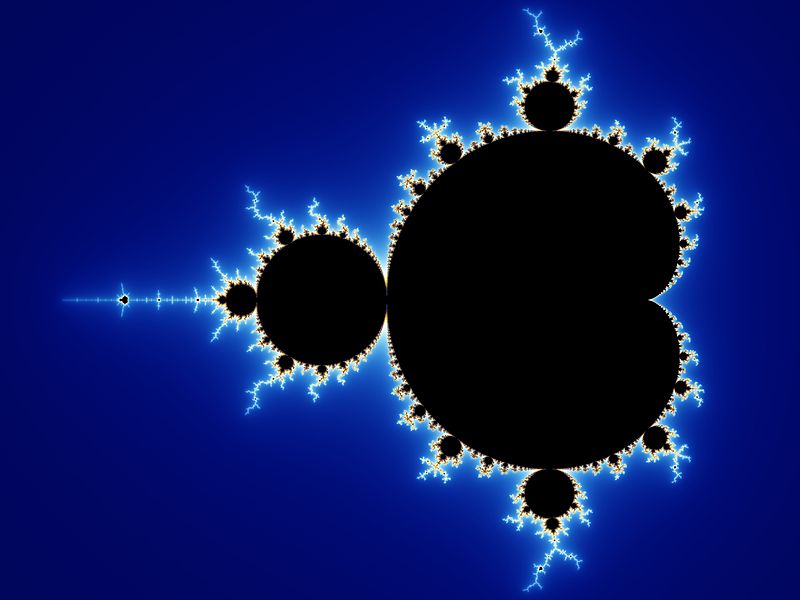 An interesting example of what I still call art is what was shown in a presentation a few weeks back: Mandelbrots set, a fractal pattern created by an equation plotted on the complex plane. Although it is on its boundary of being an art, the pattern made by this equation is a discovery, which could only be plotted by the creation of computers. It is like doing an observational painting an apple: we did not create the apple, we are discovering its form, and we are able to depict the apple using the paint brush.
I think the Mandelbrots set image along the same principles, that it is still an art because of how it is created.
There are different criterion by which we judge and place the value on art:
-Aesthetic
-Its statement
which in its sub categories has:
-Political
-Historical
-Sentimental
-Religious
From an exercise we have done in class, which spend 150CHF freely on a set of paintings, we saw that the way we judge art depends greatly on who we are. When I buy art, I buy it because it has the "I want to put it in my living room" factor. Some people enjoy the meaning of the art much more, and others like the impact of the statement the art makes.
Wednesday, March 21, 2012
John Carlin- journalist, author
 "John Carlin (born 12 May 1956)[1] is a journalist and author, dealing with both sports and politics. His book Playing the Enemy: Nelson Mandela and the Game that Made a Nation about former South African president Nelson Mandela is the basis for the 2009 film Invictus." - Wikipedia.com
"Journalism is the pass to extraordinary events, people, and parts of the world"
In this talk, John Carlin revealed to us the nature of journalism. Journalism is a medium in our media, which plays a strong role in our perception of the world. It is our source of information, which creates and shapes our opinions and perception.
In this talk, Carlin told us anecdotes and messages he had picked up from his experiences. His far most memorable and cherished were his encounters with Nelson Mandela, whom he described to have a charisma and confidence of a hero. Carlin's first encounter with this great man was at his release after 27 years of imprisonment; when he stepped out, surrounded by media including Carlin, ready to change the country. Working for the Independent at the time, Carlin had felt, and known, that this was a great moment in history, and to be witnessing it was one of the privileges of a journalist.
Mandela's challenge after becoming president was going to be to negotiate on opposition arms. In an interview, Carlin asked him what his formula was going to be. Mandela answered he was going to reconcile black aspirations and white fears: "Respect" for one another is one of the most important social qualities, and in order to reach an understanding and gain respect, he had to know his enemy better. This Mandela had done by learning Afrikaans during his imprisonment, and getting to know the culture and individual personalities of the brutish white prison guards.
This helped Mandela, as he won over the respect of the prison guards, later the Chief of "In"justice, the head of Secret Intelligence, and even the leader of a white opposition group that emerged, who was an ex-general, ambitious to oppose. By respecting this leader greatly, Mandela was able to convince the 'terrorist' to abandon the group and participate in elections. "I was told I was a coward to talk to the opposition leader. They were wrong: I managed to obtain peace."(Mandela). The respect for the white culture also included the aim that even in the newly reformed country, there had to be a sense of belonging for everyone. When the new government was deciding upon an national anthem, Mandela was wise and made the decision to have both the black and white anthems, so there would not be a feeling of separation and black dominance over the country. Mandela had great political leadership: the power to bend people to your will. He invested a lot of immense respect and trust in people for this, but instead, when he felt betrayed, he was implacable.
So what was Carlin's view on the nature of journalism? What he had recounted for us showed this: it was a witness account of Carlin's experiences, where he tried to be accurate as possible about the events and the atmosphere, yet there was also messages within this story. "Objectivity in journalism is impossible", and all people have a bias. Carlin stated that "objectivity is a myth", but at least he tried to be as truthful as possible in what he wrote.
Thus Carlin commented that the reliability of articles were that they were "only approximations of the truth". Some journalists will have more elements of inventions, with ulterior motives. Carlin himself said he was a mercenary, writing articles on various subjects because he was asked to. Nonetheless journalism is normally the best attempts at the truth, by the journalist.
Wednesday, February 29, 2012
History (cont.)
History can be a hagiography, a morality tale, and a
cautionary tale, all to some extent, because history normally has a purpose for
being told. If history is being taught in school, it is not only to educate
children on facts of the past, but also to present to them morals and cautions
which can be learnt from our history.
For example, there are many elements omitted by Japan in
their history textbooks, including facts about their conflict with China and
the invasion of Manchuria. Although it seems here that the historian is
deliberately twisting the truth, it is not necessarily false, and it is history
written for young Japanese students. The bias comes not only from the
historian, but also from the audience, who supply the demand for history that has a
ulterior motive.
Rwandan Genocide and the Truth reconciliation commission
The talk on the Rwandan genocide raised questions on what
is evil. Philip Zimbardo, the professor who conducted the Stanford prison
experiment in 1971, defined evil as someone who abuses power by intentionally
hurting another person. He also created a thesis, The Lucifer Effect, which
looks at what brings out the evil in ‘good’ people. Therefore, when looking at
history and judging why certain decisions were made, we need to look at the
power dynamics of the time. For example, being the one who feed the information to the public gives one power. That person has the power of language, and can manipulate the thoughts of people in different ways.
Conflict is mostly caused by everyone thinking they are the victims to a problem. Nonetheless, an apology doesn't necessarily solve the problem, as it can be hollow. In the case of USA's apologies to its indigenous communities, the apologies do not mean a lot. However, in the case of Japan and China's ongoing rivalry, neither are willing to admit any responsibility and apologize. I think conflict is almost unavoidable, but as long as the rivalry is relatively peaceful, then it is just like rivalry between sport teams, except political. As long as the living standards of the people are relatively good, violence or major events do not occur.
Conflict is mostly caused by everyone thinking they are the victims to a problem. Nonetheless, an apology doesn't necessarily solve the problem, as it can be hollow. In the case of USA's apologies to its indigenous communities, the apologies do not mean a lot. However, in the case of Japan and China's ongoing rivalry, neither are willing to admit any responsibility and apologize. I think conflict is almost unavoidable, but as long as the rivalry is relatively peaceful, then it is just like rivalry between sport teams, except political. As long as the living standards of the people are relatively good, violence or major events do not occur.
Wednesday, February 22, 2012
AOK- History
-What shapes the views of a historian? (PERCEPTION)
-Do historians look at facts emotionally?( EMOTION)
-Do historians piece together the past through reason? (REASON)
-Is language the most effective weapon of the historian? (LANGUAGE)
-Do historians look at facts emotionally?( EMOTION)
-Do historians piece together the past through reason? (REASON)
-Is language the most effective weapon of the historian? (LANGUAGE)
Evidence which recreates history for us, are often buried in
a certain chronology and has been treated in a certain manner which also
provides information about the piece of evidence. For example, by looking into our
garbage, we can discover clues to the past. However, history is a process where
we interpret the evidence, and present it in a certain way. It is a science and
an art, because it includes the process of
searching evidence that supports a certain hypothesis, and is a skill
which is creative, interpretive, and is part of the art of argument.
The factors that shape the views of the historian are
important, because people have different
backgrounds, and the differences in their background causes different
interpretations . Bias is subjective, because we cannot judge objectively if we are being lenient
towards one argument.
Although the opinions of a historian should not be affected by
irrational emotions, historians do see facts emotionally. In fact, if we were
presented with just the facts of an event, we may not be able to understand its
importance: it is when historians interpret the facts for us, and recount the
event with emotion that history seems to have a greater meaning. “Facts do not
speak for themselves”- the facts alone do not present the past, but it is the
historians, who are emotional beings, who present the past.
History, being a science, should be pieced together through
reason. A good historian will use empathy as a tool to understand the
motivations for decisions made in the past, analyze its expedience, and be able
to examine the personalities of the decision makers, as well as their
circumstances and other extraneous factors. It seems unlikely that all the
history presented to us has gone through this thorough process with objectivity.
It is also logical to say that the past may be pieced together to someone’s
advantage, including the historians. This makes the history presented still
logical, but maybe not as truthful or objective as people may perceive it to
be.
Language is the medium with which a historian presents
his/her interpretation. The significance of the language used is that it can
evoke emotion or even shape a person’s perception. It is also important as a
means to find out the truth, because it is when people and opinions debate upon
facts, we are able to approach the truth.
Wednesday, February 1, 2012
How much control do you have over your own future?
The control we actually have over our own future is small. So many factors influence our future: politics, the economy, the weather, accidents, the people we meet etc. We often have a decent amount of choice in our actions and how we think, but sometimes even this is restricted in the bigger picture. When we meet someone from a different culture, the person is often strongly influenced by their surroundings and culture. It is a bit like the frog in the well: we can't actually have a perception without society's filters, so even in a 'free democratic' state, our decisions and future are guided by our influences and circumstances. It is not like we can't change our future, but I think a lot of luck is involved in destiny.
Can people with different opinions be right?
What can a personal story tell us about the big issues?
In our discussion, wealth was considered an important factor in how much control we have over our future. The more money we have, the more opportunities we can create and the more hope we can buy. However, the majority of us would choose good health and spirit over infinite wealth.
I think that what makes us happy and having control over the future are separate. A lot of people want a stable, fairly simple future: a family, a house, maybe a car etc. Having a more secure grasp of our future would help us achieve this, but often the ultimate aim is to be secure and happy.
The control we actually have over our own future is small. So many factors influence our future: politics, the economy, the weather, accidents, the people we meet etc. We often have a decent amount of choice in our actions and how we think, but sometimes even this is restricted in the bigger picture. When we meet someone from a different culture, the person is often strongly influenced by their surroundings and culture. It is a bit like the frog in the well: we can't actually have a perception without society's filters, so even in a 'free democratic' state, our decisions and future are guided by our influences and circumstances. It is not like we can't change our future, but I think a lot of luck is involved in destiny.
Sunday, January 22, 2012
Hoping for a better day ~Reflections on Israel and Palestine
This presentation made me reflect upon what is needed in conflict resolution.
The problems between the Israelis and Palestinians have made people suffer for a long time. While at first the problem began with a disagreement of beliefs and identity, because the conflict becomes political, it becomes impossible for anyone to live in Israel without having their day-to-day lives affected by this conflict.

"Maslow's hierarchy of needs"
I found Andrew Watson's reference to Maslow's hierarchy of needs interesting: the needs of people living in the conflict-affected areas are being less and less fulfilled, bringing their level of fulfillment down to safety, and sometimes even to physiological. Their worries for tomorrow are so simple, yet due to a difference in identity, people cannot achieve these basic needs.
Problem solving is at the top of this hierarchy. To have the emotional capacity to be able to solve problems, reduce prejudice, accept and respect others, first the bottom needs need to be attained. The situation in which the people live in though, cannot address these needs. The longer the people are deprived of basic needs, the more the situation aggravates: an example being a change in attitude, where people begin to use definitive language and hold dogmatic views. The children grow up in this environment, and the views of their parents are passed on through the generation. The views begin to lose sight of the reason the conflict happened in the first place.
In this presentation the importance of education was justified, because respect for each other can be promoted, and a attitude towards conflict resolution can be created, especially because people have suffered enough hard times. Educating the younger generations can help create understanding of the problems that exist, and create a generation who know how to work towards conflict resolution.
The problems between the Israelis and Palestinians have made people suffer for a long time. While at first the problem began with a disagreement of beliefs and identity, because the conflict becomes political, it becomes impossible for anyone to live in Israel without having their day-to-day lives affected by this conflict.
"Maslow's hierarchy of needs"
I found Andrew Watson's reference to Maslow's hierarchy of needs interesting: the needs of people living in the conflict-affected areas are being less and less fulfilled, bringing their level of fulfillment down to safety, and sometimes even to physiological. Their worries for tomorrow are so simple, yet due to a difference in identity, people cannot achieve these basic needs.
Problem solving is at the top of this hierarchy. To have the emotional capacity to be able to solve problems, reduce prejudice, accept and respect others, first the bottom needs need to be attained. The situation in which the people live in though, cannot address these needs. The longer the people are deprived of basic needs, the more the situation aggravates: an example being a change in attitude, where people begin to use definitive language and hold dogmatic views. The children grow up in this environment, and the views of their parents are passed on through the generation. The views begin to lose sight of the reason the conflict happened in the first place.
In this presentation the importance of education was justified, because respect for each other can be promoted, and a attitude towards conflict resolution can be created, especially because people have suffered enough hard times. Educating the younger generations can help create understanding of the problems that exist, and create a generation who know how to work towards conflict resolution.
Wednesday, January 11, 2012
10 Thousand Miles (film)
What did we see that surprised us?
The style of the movie and the plot were good, but not many of the elements in the movie actually ‘surprised’ me, because I have a father who travels often to these areas of the world, who’s told me about their situation, and I think their cultural background is more similar to that of Japan than that of the Western world.
What I felt was interesting was that the university students that appeared in the film that they mostly wanted just to have a family, and didn’t feel a great desire to travel. Most of them didn’t have the means to travel, but it was also that they didn’t have much motive to travel. In comparison to the allegory of ‘the frog in the well’, it seems that people are perfectly content staying ‘in the well’.
What was TOK about this?
The main idea of ‘the frog in the well’; having a limited perception/vision of the world, and going on a journey which stretches this perception was TOK. Each person came from a different background and experienced situations and saw what they had not known before. This gaining knowledge by aquaintance and learning about different ways of thinking is TOK. It was also interesting that Liam, the producer of the film, felt essentially that what the western media portrays of this part of the world, and what the ‘local’ Chinese media portrayed showed completely seperate images. From his first hand experience, he described as reality being somewhere in between, which I think is the case with most medias.
‘Politically Correct’
Political correctness is often mocked because of its extent that it becomes ludicrous. In the radio show that we listened to in class, the man mentioned ‘gaijin’, which means foreigner in Japanese. I think the separaration between what is and what is not is not always so clear, and the term ‘gaijin’ is a good example of this. It seems to me that in Japan because of the common use of this word, it is almost implanting a discrimatory notion in Japan, that people are either Japanese or not.
What did we see that surprised us?
The style of the movie and the plot were good, but not many of the elements in the movie actually ‘surprised’ me, because I have a father who travels often to these areas of the world, who’s told me about their situation, and I think their cultural background is more similar to that of Japan than that of the Western world.
What I felt was interesting was that the university students that appeared in the film that they mostly wanted just to have a family, and didn’t feel a great desire to travel. Most of them didn’t have the means to travel, but it was also that they didn’t have much motive to travel. In comparison to the allegory of ‘the frog in the well’, it seems that people are perfectly content staying ‘in the well’.
What was TOK about this?
The main idea of ‘the frog in the well’; having a limited perception/vision of the world, and going on a journey which stretches this perception was TOK. Each person came from a different background and experienced situations and saw what they had not known before. This gaining knowledge by aquaintance and learning about different ways of thinking is TOK. It was also interesting that Liam, the producer of the film, felt essentially that what the western media portrays of this part of the world, and what the ‘local’ Chinese media portrayed showed completely seperate images. From his first hand experience, he described as reality being somewhere in between, which I think is the case with most medias.
‘Politically Correct’
Political correctness is often mocked because of its extent that it becomes ludicrous. In the radio show that we listened to in class, the man mentioned ‘gaijin’, which means foreigner in Japanese. I think the separaration between what is and what is not is not always so clear, and the term ‘gaijin’ is a good example of this. It seems to me that in Japan because of the common use of this word, it is almost implanting a discrimatory notion in Japan, that people are either Japanese or not.
Wednesday, November 30, 2011
WOK: Emotion
Emotion vs Cognition
In this lecture, the justification for emotion as a way of knowing was that although emotion is a illogical, subjective, the existence of qualia (the physical reactions emotions produce) means that there is a stimulus passing through the mind, and although unconscious, it is not less subjective than perception eg. perceiving color is subjective. It involves information being processed before stimulus arrives at the perception. The emotion also has knowledge such as instincts which can be vital for survival.
Another argument was that emotion gives knowledge meaning. Logic follows an emotional reaction, and arousal is essential to all mental functions. Boredom is the lack of emotion, and knowledge has no meaning if it does not arouse emotion.
I feel this argument in a broader philosophical sense is valid, but in a practical sense, weak. If it is emotion that gives knowledge meaning, it would mean for example people who find maths boring, do not find meaning in knowing maths. This is not necessarily true. I have times when although I am not interested in something, but I know the importance of knowing it, so I learn it. There may be no immediate emotional arousal when the knowledge is acquired by individuals.
However it is true that if there was no emotion behind all the knowledge we have, knowledge probably would not have been created. We search for knowledge because we want to, because we need to, and those are emotional reactions.
In this lecture, the justification for emotion as a way of knowing was that although emotion is a illogical, subjective, the existence of qualia (the physical reactions emotions produce) means that there is a stimulus passing through the mind, and although unconscious, it is not less subjective than perception eg. perceiving color is subjective. It involves information being processed before stimulus arrives at the perception. The emotion also has knowledge such as instincts which can be vital for survival.
Another argument was that emotion gives knowledge meaning. Logic follows an emotional reaction, and arousal is essential to all mental functions. Boredom is the lack of emotion, and knowledge has no meaning if it does not arouse emotion.
I feel this argument in a broader philosophical sense is valid, but in a practical sense, weak. If it is emotion that gives knowledge meaning, it would mean for example people who find maths boring, do not find meaning in knowing maths. This is not necessarily true. I have times when although I am not interested in something, but I know the importance of knowing it, so I learn it. There may be no immediate emotional arousal when the knowledge is acquired by individuals.
However it is true that if there was no emotion behind all the knowledge we have, knowledge probably would not have been created. We search for knowledge because we want to, because we need to, and those are emotional reactions.
Wednesday, November 23, 2011
Language II
Swearing
As a part of using language as a means of knowing, we
looked at the implications of swearing. In the day-to-day life we use it
normally as strong means of expressing. We also looked at the literal meanings
of swear words in different languages:
English=sexual
French=sexual
Quebecois=religious
Dutch=disease
Swedish=religious+ sexual
Danish=Devil, Satan, Hell
Finnish=Devil, illness
Japanese=animal+ sexual
There seems to be a similarity, that most of these are
sources of fear.
However I think
the word ‘swearing’ in itself already reflects the English language and
culture, and trying to look at the different swear words in different languages
already specifies what we mean by swearing. In French we would call these words
‘gros mots’, and in Japanese we would just call this type of language ‘dirty’.
I agree that most languages will have ‘bad’ and ‘taboo’ words to express strong
emotion, but especially as we get away from the European languages and look at
languages of completely different origins, this doesn’t apply directly the way ‘swear
words’ have a role in English.
Humor
Humor is strongly linked to language and culture. My
personal experience about this is again from my origins, Japanese. There is a
type of comedy (like stand-up comedy or ironic humor) that exists only in
Japan, which consists of being silly going along with a joke, and someone else
intervening and saying the ‘punch line’. This sounds really weird in any other
language and is completely alien to even cultures closer to Japanese like Korea
or China. There is also an expression, “Go get laughter even if it sacrifices
yourself (physically)”, which explains
the Japanese TV shows where people do the craziest things.
Saturday, November 19, 2011
Language
For language we had lectures by three different teachers, who looked at different aspects of language in TOK: different languages and perception through language, how language is used to manipulate etc.
I feel that perception of the world through different languages is a really significant part of our lives (as students of an international school). Most of us are polyglots, and we have a feel for different registers, such as colloquial, academic etc. The school we are in is bilingual, and by speaking both English and French, we all have a feel for different cultures as well. I think understanding a language helps get an insight into the culture relating to the language, because there are expressions and notions in different languages which translation destroys. For example French is a very flowery expressive language compared to languages such as German, English, Spanish, because it was originally the language of the diplomats. This is really true (statement from experience), because a sentence in English could take twice as long in French.
There was also a really interesting example that links language and perception.
http://www.youtube.com/watch?v=4b71rT9fU-I
This tribe has a different system for naming colors, which in fact allows them to distinguish colors that we can't easily. I also experience this when I talk Japanese and English: for example the word 悔しい(kuyashii) in Japanese describes an emotion between frustration and regret, which I don't know how to describe in English, and I actually feel most people that don't speak Japanese don't feel this exact emotion. It links to the quote, "If you can't say it, you don't know it".
I feel that perception of the world through different languages is a really significant part of our lives (as students of an international school). Most of us are polyglots, and we have a feel for different registers, such as colloquial, academic etc. The school we are in is bilingual, and by speaking both English and French, we all have a feel for different cultures as well. I think understanding a language helps get an insight into the culture relating to the language, because there are expressions and notions in different languages which translation destroys. For example French is a very flowery expressive language compared to languages such as German, English, Spanish, because it was originally the language of the diplomats. This is really true (statement from experience), because a sentence in English could take twice as long in French.
There was also a really interesting example that links language and perception.
http://www.youtube.com/watch?v=4b71rT9fU-I
This tribe has a different system for naming colors, which in fact allows them to distinguish colors that we can't easily. I also experience this when I talk Japanese and English: for example the word 悔しい(kuyashii) in Japanese describes an emotion between frustration and regret, which I don't know how to describe in English, and I actually feel most people that don't speak Japanese don't feel this exact emotion. It links to the quote, "If you can't say it, you don't know it".
Wednesday, November 2, 2011
Subjective knowledge
Today in TOK I came to realize how much the importance of different types of knowledge is subjective and personal. In an exercise where we were given the IB hexagon subjects and ranked them in order that we thought was closer to the Truth, my three top subjects were my Higher Level subjects: Maths, Physics, and Art. If I were to justify my reasons for each of them, I would find my personal views and preferences would interfere.
This was really interesting because, although for example maths is thought to be close to the truth by many people, personal taste could change this opinion. For a person who feels maths is less significant in their life, maths would seem further away from the truth.
Also, I honestly can agree with the quote by Louis Armstrong, "Man, if you have to ask what it is, you'll never know." I've been through personal experiences where whether or not a person 'feels it', or 'gets it' really changes their knowledge and perception. I think this is appears in most art forms; Personally I see this most in music, where I have a wide range of taste. If a person likes one genre but doesn't like another because he doesn't 'get it', he'll never know. When a picture paints a thousand words but an interviewer has to ask an artist why what he has done is good, the interviewer will never know.
This relates to how personal opinion affects our perception, because a person may not be able to see the importance of something, due to 'not getting it' or 'not feeling it'. I think understanding this helps in trying to create compromise and enables people to empathize.
Thursday, October 27, 2011
Breyten Breytenbach
We had a guest speaker at school for TOK: Mr.Breyten Breytenbach.
http://en.wikipedia.org/wiki/Breyten_Breytenbach
He had a very interesting life and perspective to share with us; an unimaginable experience compared to the world we live in. Mr. Breytenbach was an activist opposing the Apartheid rule in South Africa.
He mentions when he lived in South Africa, he lived in a privileged part of the country- which he called a 'false paradise'. It was a place referred to as 'multi-cultural', but it was on the verge of violence. "70% of the people in South Africa couldn't participate in the country's normal activities," he told us. Mr.Breytenbach describes his younger self, when he was a protester and went to exile, as idealistic.
In the 80's/90's, Nelson Mandela was released, and a new government was formed. The Apartheid government Mr. Breytenbach opposed, came to an end.
However, his opinion was that even now, South Africa is not out of the 'woods'. The systems that South Africa uses (administrative, political, economical) are not functioning as they should be. The idealism of when Nelson Mandela was in power died down, and the country is not united, and going forwards. And when things aren't going well, people look back at their differences: ethnicity, values etc.
He believes there is no Truth he cold imply on anybody else. There is tension between belief people adhere to, and the structure people do believe in. A Buddhist concept he likes is that people are closest to the truth only when he is not attached to it (eg. has his own views on the subject)
A life without attachment is the perfect life. But sometimes the illusions in life can be worth them as they are so beautiful.
I enjoyed listening to Mr.Breytenbach, because he has an insight that is meaningful, and has experience which works as its evidence, which has the power to convince. I felt that similar to what he witnessed, in the modern world there is also a lot of idealism, and people are united not with the same ideals, but are united because they blame the same thing, often the government.
For example, I still don't quite understand what the recent Wall Street protests are about. At times it seems like people just hate bankers, at other times people want a better distribution of wealth because the richest are rich, and now because there was violence in a protest and there were victims.
Mr.Breytenbach had an opinion which I enjoyed, which was that the protests had a short-sighted view: it was not engaging to make a world a better place, and a young rebellion doesn't bring about compromise.
I understand that something has to be done, an initiative has to take place, to bring about change. Nonetheless is there really a point if we all don't really aim towards the same objectives and ideals, and just work together temporarily to crush whatever we have now?
I know I'm not idealistic, but I don't think the world is getting worse. I don't feel its getting better, but if I were to choose the world 50 years ago and the world now, I would choose now.
http://en.wikipedia.org/wiki/Breyten_Breytenbach
He had a very interesting life and perspective to share with us; an unimaginable experience compared to the world we live in. Mr. Breytenbach was an activist opposing the Apartheid rule in South Africa.
He mentions when he lived in South Africa, he lived in a privileged part of the country- which he called a 'false paradise'. It was a place referred to as 'multi-cultural', but it was on the verge of violence. "70% of the people in South Africa couldn't participate in the country's normal activities," he told us. Mr.Breytenbach describes his younger self, when he was a protester and went to exile, as idealistic.
In the 80's/90's, Nelson Mandela was released, and a new government was formed. The Apartheid government Mr. Breytenbach opposed, came to an end.
However, his opinion was that even now, South Africa is not out of the 'woods'. The systems that South Africa uses (administrative, political, economical) are not functioning as they should be. The idealism of when Nelson Mandela was in power died down, and the country is not united, and going forwards. And when things aren't going well, people look back at their differences: ethnicity, values etc.
He believes there is no Truth he cold imply on anybody else. There is tension between belief people adhere to, and the structure people do believe in. A Buddhist concept he likes is that people are closest to the truth only when he is not attached to it (eg. has his own views on the subject)
A life without attachment is the perfect life. But sometimes the illusions in life can be worth them as they are so beautiful.
I enjoyed listening to Mr.Breytenbach, because he has an insight that is meaningful, and has experience which works as its evidence, which has the power to convince. I felt that similar to what he witnessed, in the modern world there is also a lot of idealism, and people are united not with the same ideals, but are united because they blame the same thing, often the government.
For example, I still don't quite understand what the recent Wall Street protests are about. At times it seems like people just hate bankers, at other times people want a better distribution of wealth because the richest are rich, and now because there was violence in a protest and there were victims.
Mr.Breytenbach had an opinion which I enjoyed, which was that the protests had a short-sighted view: it was not engaging to make a world a better place, and a young rebellion doesn't bring about compromise.
I understand that something has to be done, an initiative has to take place, to bring about change. Nonetheless is there really a point if we all don't really aim towards the same objectives and ideals, and just work together temporarily to crush whatever we have now?
I know I'm not idealistic, but I don't think the world is getting worse. I don't feel its getting better, but if I were to choose the world 50 years ago and the world now, I would choose now.
Friday, October 7, 2011
Perception & Ways of Knowing (Logical Reasoning)
Perception
- trust senses => better combined.
- illusion
- empiricism
- 'tabula rasa'
- perception filters => subjectivity (view of the world)
- empathy
- confirmation bias
I also feel that my Japanese background helps me understand this: Japan has such a different secluded culture, which I have not grown up in but understand a lot of, which I know most 'foreigners' (most people who've lived in Japan would understand this notion) just won't understand.
Ways of Knowing: Logical Reasoning
- Argument/Premise/Conclusion
- Sound Logic
- A valid/true argument
- A logical fallacy
- Inductive/Deductive Logic
- Inductive Sufficiency
- Fallacy:
- Appeal to fear & false choice
- Ad hominem
- False Clause
Subscribe to:
Posts (Atom)